Frequently Asked Questions
SAFARI FAQ
Our itineraries are tailored to seasonal game movement patterns, ensuring excellent wildlife viewing year-round. The best time to travel to Tanzania depends on your interests, the places you wish to visit, and the activities you want to experience.
For example:
- Elephants: Visit Tarangire National Park during the height of the dry season (July to October) to see massive herds congregating around the Tarangire River.
- Kilimanjaro Trekking: Avoid April and May when the long rains can make trekking challenging.
- Great Migration - Wildebeest Calving: Travel during the green season (December to April) to see the migration spread across the southern and eastern Serengeti. The wildebeest calving typically occurs in 2-3 week span in February.
- Great Migration - Mara River Crossings: Witness the dramatic crossings during the dry season (mid-July to October).
Whatever month you choose, we will design your itinerary to ensure you’re in the right parks and regions for the best wildlife viewing.
The Great Migration is an annual cycle of movement involving over 1.5 million wildebeest, 250,000 zebras, and 400,000 Thomson’s gazelles as they search for water and green pastures across the Serengeti ecosystem. While the annual route is fairly predictable, the timing can vary depending on rainfall patterns.
- December to early May: Considered the green season and the migration typically gathers on the southern and eastern Serengeti plains with majority of the female wildebeest giving birth in a 2 to 3 week time span in February.
- Late May to early July: As the plains begin drying up, the herds move to the Central Serengeti then westward to the Western Corridor during this transitional period.
- Mid-July to October: Considered the dry season, the herds move to the North Serengeti and remain there for the duration of the dry season crossing back and forth across the Mara River in search of greener pastures. During the peak dry season, some portion of the herds will cross into Kenya’s Masai Mara.
- November: The rains return to the southern plains, restarting the migration cycle.
Tanzania has two main seasons:
- Dry Season (June to October): Generally cool and dry.
- Green/Rainy Season (November to May): Features heavier rains from March to May and a short dry spell between January and February.
The northern safari circuit parks are at high elevations, offering a pleasant climate for game viewing even during midday. Typical temperatures:
- Serengeti: Warm months (October to March) range from 29°C (high) to 17°C (low); cooler months (April to September) range from 26°C (high) to 13°C (low).
Ngorongoro Crater Rim: At over 2,200 meters, nighttime temperatures can drop below freezing during the cooler months and warm clothing are necessary in the evenings and for early morning game drives.
For peak/high season travel (June – September, Christmas/New Years holiday season & February), we recommend booking at least 12 months in advance to secure your preferred accommodations. While we can arrange safaris on short notice, availability of accommodations may be limited.
To start planning your safari:
- Fill out our online inquiry form.
- Email us at info@avidsafari.com.
- Call us at +255 787 988 024 (Tanzania time is GMT+3).
We respond promptly to all inquiries, but please allow up to one business day for replies due to time zone differences.
We request that your deposit to secure a reservation and the balance of the safari payment be made in US dollars by wire transfer into Avid Safari’s Tanzanian U.S. dollar bank account. Credit card payment options are available but will incur a 3.9% surcharge.
All deposits and payments received into the company’s bank account will be held on your behalf. We only disburse funds to the appropriate suppliers as necessary until we have completed delivering our services to you.
Cancellations are effective upon the date of receipt of written notification in our office.
- 90 days or more prior to departure are subject to a cancellation penalty of 25% of the total trip price.
- 89 to 61 days prior to departure are subject to a cancellation penalty of 50% of the total trip price.
- 60 days or less prior to departure are subject to a cancellation penalty of 100% of the total trip price.
Included:
- All accommodations
- All meals, unless otherwise indicated in your itinerary
- All airport and hotel transfers
- All national park entrance, concession, and camping fees
- Extended Safari Landcruiser with unlimited kilometers for game drives
- Services of a professional English-speaking Tanzanian driver-guide
- Internal airfare (if applicable)
- Use of binoculars while on safari (two sets are provided for each vehicle) & wildlife field guide reference books
- Unlimited bottled drinking water, selection of soft drinks & juices, coffee, tea, and local beer in your Safari Landcruiser
- AMREF Flying Doctor’s membership
- 18% VAT tax
Not included:
- International airfare to and from Tanzania
- Tanzania tourist visa fee
- Gratuities to your driver-guide & lodge/camp staff
- Comprehensive travel insurance
- Laundry and drinks at the lodges and camps
- Shopping and items of a personal nature
Optional activities such as balloon safaris, walking safaris, and Maasai village tours not listed in your itinerary
If you are coming from North America or Europe, we recommend flying Delta, KLM, or Air France to Kilimanjaro International Airport (JRO). If you are coming from Asia, we recommend flying Qatar Airways or Ethiopian Air to Kilimanjaro International Airport (JRO).
If you are planning a visit to Zanzibar after your safari, we recommend arranging your international flight so that you arrive at JRO and depart through Zanzibar International Airport (ZNZ) or Dar Es Salaam International Airport (DAR).
Please confirm all international flights and seating prior to departure.
Unfortunately, we do not book international flights. However, all domestic internal flights included in your safari itinerary will be arranged by us, and the cost is included in the safari price.
If your flight is delayed or there is a flight schedule change and we need to modify your accommodations, internal flights, transfers, etc., any additional expenses incurred as a result will be your responsibility. We will not be able to obtain refunds from suppliers for unused accommodations, internal flights, or other services already paid.
For international flights, please check with your individual airline as check-in and carry-on luggage restrictions vary by airline. For domestic internal flights from Arusha to the Serengeti or Arusha to Zanzibar, the luggage restriction is 20 kg (44 lbs) per person, including both check-in and carry-on items. We recommend using duffel bags or soft-sided luggage rather than rigid suitcases. Excess luggage can be accommodated at the discretion of the airline, and additional charges will apply.
E-visa in Advance
We recommend obtaining a Tanzania e-visa in advance of your arrival. Please read the guidelines carefully to determine whether you require a visa and how to apply: Tanzania eVisa - Guidelines.
Apply for a Tanzania e-visa here: Tanzania eVisa - Welcome.
Visa on Arrival
You can also obtain your Tanzania tourist visa on arrival at Kilimanjaro International Airport. Please fill out the Tanzania landing card, which is usually handed out during your flight, and have your visa fee ready in cash.
Ensure you have two blank pages in your passport, and your passport does not expire within six months of your arrival date.
Is Tanzania a safe country to visit?
Since its independence in 1961, Tanzania has been a politically stable country and one of the safest countries to travel to in Africa.
We do, however, recommend that you use common sense and take safety precautions as you would when traveling in any foreign country:
- Leave jewelry and expensive watches at home.
- Keep all your important documents and cash in a money belt hidden under your clothes at all times (even on game drives or while dining at the lodge or camp).
- Keep a copy of all important documentation (passport, itinerary, insurance policy, credit cards, etc.) locked in your suitcase.
- When shopping, carry a few dollars for spending money in an easily accessible pocket rather than displaying your money belt.
- Do not walk around town after dark in Arusha, Dar Es Salaam, or Zanzibar—always take a taxi, even if you are only going a block or two.
Safaris are a considerable investment, and we strongly urge you to purchase comprehensive travel insurance. Coverage should include trip cancellation, delay or interruption, lost or delayed baggage, emergency accident, illness and evacuation, 24-hour medical assistance, and traveler’s assistance. Avid Safari does not include travel insurance or any protection plan in its safari price.
We highly recommend that you consult with your physician or a travel medical doctor for advice several months in advance of your trip, as you may need a series of vaccinations. Please ensure that you indicate that you will be traveling to Tanzania on safari. Your doctor will be able to suggest which vaccinations and medications are advisable. Anti-malarial medication is strongly recommended and should be discussed during your doctor’s visit.
All vaccinations are voluntary for entry into Tanzania with the exception of the Yellow Fever vaccination. If you are entering Tanzania from a Yellow Fever-infected country such as Kenya, Uganda, Ethiopia, or Rwanda, you will be required to show a Yellow Fever Vaccination Certificate upon arrival in Tanzania. Please ensure you carry this Certificate with your passport. If you are entering Tanzania from Europe, you will not be required to show a Yellow Fever Vaccination Certificate.
Family safaris are a wonderful opportunity for children to learn about wildlife, participate in cultural activities, and interact with local children. We can tailor your safari to visit a local primary school or orphanage to see how other children live, learn, and play. Please note that most safari lodges and camps are not fenced, and wildlife moves about freely. Never let a child out of your sight or wander around unattended under any circumstances. Listen carefully to all safety briefings from your guide and lodge staff, and follow instructions, especially concerning moving to and from your tent/room after dark.
If you have any special needs or requirements, please let us know when you book your safari. Whether it’s wheelchair accessibility or allergy to specific foods, we can plan your itinerary accordingly.
All game drives are conducted using a 4-wheel drive Extended Landcruiser, which can accommodate up to six passengers. Each traveler is guaranteed a window seat. We have no mileage restrictions on game drives. For safety and communication, our vehicles are equipped with a long-distance radio.
Our safaris are tailored to suit your preferences and budget and offer a wide choice of accommodation categories, from standard and deluxe to luxury hotels, lodges, and tented camps. Each property will have its unique character, and all of them are clean, comfortable, and include bathroom facilities.
Most meals on safari cater to Western tastes, and some lodges also offer a sampling of local Tanzanian food. A vegetarian choice is typically available on every menu. We ask that you notify us of any special dietary requirements in advance of your safari.
Be prepared for bumpy and rough road conditions during game drives and transfers within the national parks and conservation areas. The main roads to and from Arusha to Tarangire National Park, Lake Manyara National Park, and the Ngorongoro Conservation Area Gate are completely paved, but the roads within the national parks and conservation areas are not. Remember, traversing rough roads and tracks is a part of the excitement of the African game driving experience. If you suffer from back problems or other conditions which may be aggravated by driving long distances on rough roads, please let us know.
Tanzania offers a variety of locally handmade crafts such as exquisite wood carvings, masks, antiques, woven baskets, colorful Maasai beadwork, paintings, etc., and you will have plenty of opportunities to shop during your visit.
Many curio shops are located along the major roads heading to and from the national parks. Most hotels, lodges, and camps have gift shops, and in Arusha, there are multitudes of souvenir shops and markets to choose from. The largest and most popular include the Cultural Heritage and the Maasai Market located near the Clock Tower. Prices are negotiable at most curio shops and markets, with the exception of Cultural Heritage and some hotel gift shops. The larger curio shops, hotel & lodge gift shops, and Cultural Heritage accept major credit cards. Additionally, both Kilimanjaro International Airport and Zanzibar International Airport also have gift shops that carry a good selection of items for your perusal while waiting for your flight.
If you are fond of gemstones and jewelry, then the rare and precious Tanzanite may be of interest to you. Tanzanite is a beautiful dark blue gemstone unique to Tanzania and only mined near Kilimanjaro Airport. If you are interested in purchasing Tanzanite, please let us know, and we will take you to visit a Tanzanite specialist for certified gemstones to ensure good quality and value.
Most lodges and camps use solar power and electricity is available 24 hours a day for room lighting and charging of batteries. However, the use of hair dryers is usually restricted to times when the generator is turned on. Please inquire at check-in, as policies vary with each lodge or camp on the use of hair dryers.
Electrical sockets in Tanzania are three-square-pin, the same as in the United Kingdom, and the electrical voltage is 220V. It is recommended to carry a universal adapter to accommodate your devices.
Your mobile phone may work in some areas of Tanzania's national parks and conservation areas, as there is mobile or cellular coverage in several locations. However, reception is often inconsistent, and signals can be weak, especially in remote areas like the Northern and Western Serengeti, where there is no signal. Most lodges and camps, however, provide free Wi-Fi, enabling you to stay connected with friends and family.
Yes, U.S. dollars are widely accepted in Tanzania, especially in tourist areas. Keep the following in mind:
- For denominations of $20, $50, and $100, only bills issued after 2006 are accepted due to counterfeiting concerns.
- Smaller denominations like $1, $5, and $10 are also accepted but are less commonly used for larger transactions.
Additionally:
- Tanzania Shillings (Tsh) are the official currency.
- ATMs in major towns only dispense Tanzanian Shillings.
- Major credit cards are accepted at large safari lodges, souvenir shops, and tourist towns.
Avoid traveler’s cheques as they are not commonly accepted.
- General Tips:
- Pack casual, comfortable, and easy-to-wash clothes.
- Dress in layers to adjust to changing temperatures (cold mornings and warm afternoons).
- Stick to neutral or khaki colors to avoid attracting tsetse flies (avoid dark blue and black).
- Plan light packing; most lodges offer laundry services for a small fee.
- Clothing List:
- T-shirts and tank tops
- Long-sleeved shirts (protection from sunburns and bugs)
- Shorts and light long pants or convertible pants
- Warm fleece pullover or jacket
- Comfortable walking shoes
- Sandals or flip-flops for use at the lodge
- Wide-brimmed hat, sunglasses, sunscreen, and insect repellent
- Cotton socks, underwear, and pajamas
- A swimsuit
- Bandana (for dust)
- Heavy sweater, gloves, and a toque if visiting during the cold season (June–August).
- Long pants, long-sleeved shirts, and socks for evenings to avoid mosquito bites.
Clothing for Zanzibar
- For Beach Resorts: Relaxed, casual beachwear is acceptable.
- For Sightseeing in Stone Town or Local Areas:
- Women: Avoid sleeveless or revealing tops, short skirts, or shorts above the knee. Capri pants or knee-length shorts are fine.
- Men: Wear shirts, pants, or knee-length shorts.
What other items should I pack?
Essential Documents:
- Passport
- Plane tickets
- Travel insurance policy and emergency contact numbers
- Yellow fever vaccination certificate (if required)
- Safari itinerary
- U.S. dollars (post-2006 bills in both large and small denominations).
- Credit cards and ATM bank cards
Personal Items:
- Sunglasses, sunscreen, and lip balm
- Insect/mosquito repellent
- Small flashlight or headlamp
- Eye drops, extra contact lenses, or spare glasses
- Antibacterial hand sanitizer
- Tissue paper and a small travel towel (public washrooms may lack supplies).
- Personal toiletries
Medical Kit:
- Tylenol or ibuprofen
- Antimalarial pills
- Cold/allergy medicine and itch cream
- Stomach ache remedies, diarrhea medicine, and antibiotic (e.g., Ciprofloxacin)
- Band-aids, antibiotic cream, and prescription medications
Other Gear:
- Camera with extra memory cards, batteries, and charger
- UK plug adapter
- Zip-lock bags for toiletries, snacks, or electronics
Important Travel Tip
Carry-On Essentials:
- Pack essential items in your carry-on (e.g., prescription medications, camera equipment, toiletries, and a change of clothes). Checked luggage can sometimes be delayed or lost, so this ensures you're prepared.
- General Tips:
Start Time: Game drives typically start at 6:00 AM to maximize wildlife sightings.
- Why Early? Many animals are most active between 6:00 AM and 9:00 AM.
- Breakfast: Your guide will usually arrange breakfast boxes from the lodge to allow you to enjoy the drive without missing the best hours for wildlife activity and photography.
Yes, it’s possible to meet and interact with local communities through various activities, such as:
- Visiting a Maasai village to learn about their culture and traditions.
- Touring a local primary school or orphanage.
- Shopping at a local market for handmade crafts and souvenirs.
These experiences can be included in your itinerary, and they provide an excellent opportunity to appreciate the local culture.
Yes, wild animals can be dangerous. Here are some key safety tips:
- Always follow your guide’s instructions.
- Even animals habituated to safari vehicles (e.g., in the Serengeti and Ngorongoro Crater) are still wild and unpredictable.
- Safari lodges and camps are often unfenced, allowing wildlife to roam freely.
- Follow all safety instructions provided by the lodge or camp.
- Always use an escort or guide when walking to/from your room or tent after dusk.
- Children: Keep young children close and under constant supervision.
If unsure, always ask your guide or lodge staff for advice.
Where:
- Present in Tarangire National Park, the Western Serengeti, and parts of the Central and Northern Serengeti.
- Tsetse-free areas: The plains of the Southern and Eastern Serengeti, Ngorongoro Crater, and southern Central Serengeti.
Precautions:
- Tsetse fly bites are painful, and repellents are generally ineffective.
- Wear long sleeves and pants and avoid dark blue or black clothing, as these colors attract tsetse flies.
- Keep vehicle windows closed when driving through tsetse-infested areas.
- For bite reactions (swelling and itchiness), Benadryl can help alleviate symptoms.
Other Insects:
- Common flies: Harmless and more of an annoyance, often indicating the migration is nearby.
- Mosquitoes: Active in the evenings and can carry malaria.
- Take anti-malaria medication as prescribed.
After sunset, cover up with long sleeves, pants, and socks and use mosquito repellent containing DEET.
Expect dusty conditions, especially during the dry season when the plains are extremely dry, and wind stirs up fine soil. Even during the rainy/green season, the plains can dry quickly, leading to similar issues.
Tips to Manage Dust:
- Bring a bandana or scarf to protect your face from dust.
- Protect your camera and electronic equipment with a sealed and dustproof camera bag that can be opened and securely closed.
- Use lens-cleaning supplies to maintain your camera gear throughout the trip.
Tipping is customary but entirely at your discretion. Many Tanzanians in the tourism industry rely on tips to support their families.
Recommended Tipping Guidelines:
- Safari Guide: $10–$30 per person per day
- Park Ranger or Maasai Guide for Walking Safaris: $10–$20 per group per walking tour
- Maasai Village Visit: $10–$20 per group
- Transfer Driver (e.g., in Arusha): $10 per vehicle
- Porters/Baggage Handlers: $1–$2 per bag
- Lodge/Camp Staff: $10–$20 per room per day
Tipping Lodge/Camp Staff:
- Use the gratuity box at the reception area rather than tipping individual staff members. This ensures all behind-the-scenes workers, such as cooks, housekeepers, security guards, and room attendants, share in the tips.
KILIMANJARO FAQ
While it is possible to climb Mount Kilimanjaro year-round, it is generally recommended to plan your trek during months with favorable weather. Adverse conditions such as excessive rain, strong winds, snow, ice, and extreme cold can be physically draining, significantly lower your chances of summiting, and increase safety risks.
Typically, the best months for climbing in terms of dry weather and moderate temperatures are January and February and September and October. The months of June to August are also favorable due to dry weather, though temperatures tend to be cooler. During November, December, and March, some rain can be expected. The rainiest months are April and May, when climbing conditions are usually poor.
If you are considering climbing during the wetter months, the Rongai route is recommended, as the northern side of the mountain receives less precipitation.
It is worth noting that months with favorable climbing conditions are also the busiest, with more climbers on the trails.
The shortest route to the summit, commonly taken by trekkers, is the Marangu route, which can be completed in four nights and five days. However, the Marangu route has the highest failure rate when it comes to summiting. Why? Successfully reaching the summit is not just about physical fitness—it also depends on whether your body has had enough time to acclimatize to the high altitude.
There is a strong correlation between the number of days spent on the mountain and your chances of reaching the summit: the longer the climb, the better your chances of success.
Our advice is to add an acclimatization day, regardless of the route you choose, to ensure a safer and more enjoyable climb. Opting for a shorter route or the minimum number of days may seem like a good way to save costs, but it significantly reduces your chances of summiting. Considering the effort and expense of traveling to Tanzania for the climb, the additional cost of an acclimatization day is well worth it for a safer and more successful experience.
There are six established ascent routes to choose from: Marangu, Machame, Lemosho, Shira, Rongai, and Umbwe. The Lemosho and Shira routes start from the west side of the mountain, while the Machame and Umbwe routes approach from the south. The Marangu route starts from the southeast, and the remote Rongai route begins in the north, near the Kenyan border.
When selecting a route, consider the difficulty level, the number of days (longer is better for acclimatization), and your preferences regarding trail traffic and scenery.
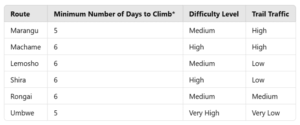
*We strongly suggest adding an acclimatization day to the minimum number of days for a safer and more enjoyable climb.
- Marangu Route - Also known as the "Coca-Cola" route, Marangu is considered one of the easiest routes due to its gradual incline and shorter duration. However, it has a high failure rate to summit because of inadequate acclimatization. The ascent and descent use the same path, making it the second most popular route after Machame, resulting in high trail traffic. It is also considered the least scenic route.
Marangu is the only route that offers dormitory-style accommodations in basic huts, providing bunk beds, mattresses, and pillows. Climbers must bring their own sleeping bags. The huts include communal dining areas and basic washrooms.
- Machame Route - Nicknamed the "Whiskey" route, Machame is the most popular trail on the mountain and is quite busy during peak seasons. It offers breathtaking scenery, taking climbers through montane forests, the Shira Plateau, Lava Tower, and Barranco Valley. Climbers will enjoy stunning views from the top of Barranco Wall and a glimpse of Kibo’s Southern Icefield from Karanga Valley. The route descends via the Mweka route.
Machame is more challenging than Marangu, with longer climbing days and steeper trails. Climbers sleep in tents at designated campsites.
- Lemosho Route - The Lemosho route offers stunning scenery and a high summit success rate due to its longer duration and lower trail traffic. It is ideal for climbers with hiking and camping experience who want a more leisurely climb.
The route begins in lush montane forests and leads to the Shira Plateau, eventually joining the Machame route near Lava Tower. Lemosho also descends via the Mweka route. While the minimum number of days for this route is six, an eight-day climb is recommended to fully enjoy the trail.
- Shira Route - Similar to Lemosho, the Shira route begins on the Shira Plateau at a higher elevation, bypassing the montane forest. This makes it more challenging, as climbers may experience altitude symptoms from the start. Shira meets up with Lemosho on day two and follows the same trail for the remainder of the climb.
- Rongai Route - The Rongai route starts near the Kenyan border and is known for its low traffic compared to other popular routes. It is a great choice during the rainy season, as the northern side of the mountain receives less precipitation.
This route winds through remote wilderness areas before joining the Marangu route at Kibo Camp. The descent follows the Marangu route.
- Umbwe Route - The Umbwe route is the steepest and most difficult trail on Mount Kilimanjaro, recommended only for experienced climbers confident in their ability to acclimatize. The fast elevation gain leaves little time for proper acclimatization, contributing to a high failure rate.
Umbwe joins the Machame, Lemosho, and Shira routes at Barranco Camp and follows the southern circuit to the summit, descending via the Mweka route.
Climbing Kilimanjaro takes you through four distinct ecological zones in a matter of days: rainforest, moorland, alpine desert, and finally, the arctic zone.
At the base of the mountain, average temperatures range from 20 to 27°C depending on the time of year. However, temperatures drop rapidly as you gain elevation and pass through the different ecological zones. At Uhuru Peak, nighttime temperatures can plummet to -25°C or even lower, especially with wind chill.
The weather on Kilimanjaro is extremely variable and can change quickly. Climbers should be prepared for extreme conditions, including rain, gusty winds, and very cold nights.
EQUIPMENT:
- Four season sleeping bag suitable for conditions reaching – 10 to -15 Celcius, sleeping mattress and small travel pillow
- Daypack (25-30 litres) and waterproof cover
- Large duffel bag to be carried by your porter
- Small & medium ziplock bags. Ziplock bags are handy for a multitude of uses.
- Headlamp
- Insulated water bottle or Camel Back/Platypus (the latter is recommended as it is easier to access and you will drink more frequently)
- Telescopic trekking poles
- Sunglasses
- Camera and/or video camera and extra memory cards and battery (note battery life is much shorter under freezing conditions)
- Power bank
- Earplugs (busy camps can be noisy)
- Pocket Knife
- Stuff sacks for sleeping bag and clothing
- Travel book, novels, deck of cards or other games for afternoon entertainment
CLOTHING:
- Waterproof trekking boots, well broken in & gators
- Extra shoes, like gym shoes or flip flops to where in camp
- Thick thermal outer socks and inner lining socks
- Waterproof/windproof breathable trousers (side zipper recommended)
- Hiking pants (convertible to shorts)
- Base layer or thermal long underwear
- Underwear, bras
- Waterproof outer gloves and inner liner gloves
- Waterproof/windproof insulated jacket
- Thick sweater or fleece top
- Base layer or thermal long sleeve shirt
- Long sleeved, light weight, moisture wicking shirt
- T-shirt
- Poncho
- Scarf for cold and bandana for dust
- Wide brimmed hat for the sun
- Toque and balaclava
- Extra shoe laces for your hiking boots
TOILETRIES:
- Toilet paper
- Kleenex or facial tissue
- Sun block
- Lip balm with sun protection
- Skin lotion (the cold and wind will dry your skin more than usual)
- Wet wipes
- Small soap
- Travel towel – light-weight and takes very little space
- Toothbrush, toothpaste, dental floss
- Deodorant
- Insect repellent
- Nail clippers/scissors
- Razor & shaving cream/gel
- Contact lens solution & extra set of lenses
- Feminine hygiene product
FIRST AID:
- High altitude medication
- Anti malarial medication
- Band aids & moleskin for blisters
- Bandages, gauze pads
- Painkiller (Tylenol, Ibuprofen)
- Antiseptic cream (Polysporin)
- Stomach ache/indigestion medicine (Pepto Bismol)
- Anti-diarrhea medicine (Imodium)
- Re-hydration salts
- Prescription antibiotic effective against a broad range of bacteria including travelers diarrhea (Ciprofloxacin)
- Any other prescription medications
- Eye rinse/moisturizing drops
MONEY & DOCUMENTS:
- Passport
- Plane tickets
- Travel Insurance Policy & Emergency Contact Number
- Yellow Fever Vaccination Certificate (if applicable)
- List of Emergency Contact Number from home
- U.S. dollars in large and small denominations ($20, $50 & $100 bills should be issued after 2006)
- Credit cards and ATM bank cards
- Medical history
Avoid Overpacking
Bring only the essentials. Porters are limited to carrying 15 kilograms of your personal belongings. If your duffel bag exceeds this weight, you’ll need to hire and pay for an additional porter. If you forget any gear, most equipment can be rented locally, but the quality may not meet your expectations.
Extra luggage, such as clothing, gear, or equipment for safaris or trips to Zanzibar, can be safely stored at your hotel.
Since checked luggage on international flights is sometimes lost or delayed, it’s highly recommended to wear or carry on essential items for your Kilimanjaro climb. This includes a complete hiking outfit, especially your hiking boots. In your carry-on, pack toiletries, medications, a camera, and all important documents.
Your day pack should only contain items you’ll need during the day before reaching the next campsite. The contents may vary depending on trail conditions, weather, and your guide’s advice. Typically, you should pack:
- Rain gear (for lower altitudes).
- Warm clothing and gloves (for higher altitudes).
- Snacks and drinking water.
- Hat, sunglasses, sunscreen, and lip balm.
- Camera gear.
- Important documents, including your passport and cash.
All other items should be securely packed in your duffel bag, which porters will transport from campsite to campsite. Ensure your duffel is locked and ready for porters each morning before setting off for the day.
All meals (breakfast, lunch, and dinner) and drinks will be provided during your climb. Below is an example of what you can expect:
Breakfast
Lunch
Snack
Dinner
Tea, coffee, hot chocolate
Water or juice
Tea, coffee, hot chocolate
Tea, coffee, hot chocolate
Porridge
Sandwich
Roasted peanuts
Soup
Toast or crepe with peanut butter, jam, or honey
Boiled egg
Popcorn
Salad
Eggs and sausage
Roasted chicken
Stewed vegetables with beef, chicken, or fish
Beans
Cheese
Rice pilaf
Fruit
Chocolate bar
Potatoes
Snack
Fruit salad
Drinking Water
Plenty of drinking water will be boiled, cooled, and provided each day to ensure you stay hydrated. You’ll receive water each morning before setting off on your hike, and additional drinking water will be available when you arrive at your next camp in the afternoon. While there is no need to chemically treat the water, you may choose to do so if you prefer.
Additional Tips
- Consider bringing your favorite snacks, such as Gatorade powder, candy bars, or energy bars, for an extra boost during your climb.
- If you have any special dietary requirements or restrictions, please inform us at the time of booking so we can accommodate your needs.
Kilimanjaro is a serious mountain, and the risks associated with climbing it should not be taken lightly. While not widely discussed, nearly 1,000 climbers are evacuated from the mountain annually, and approximately 10 deaths are reported each year, mostly due to altitude sickness.
Altitude sickness, or Acute Mountain Sickness (AMS), occurs when the body fails to adapt quickly enough to the reduced oxygen levels at higher altitudes. Although the oxygen percentage (21%) remains constant from sea level to the summit of Kilimanjaro, the barometric pressure decreases as altitude increases. This results in less oxygen being absorbed by your body with each breath. For example, at 3,600 meters, the barometric pressure is about 630 mb (480 mmHg), compared to approximately 1,000 mb (760 mmHg) at sea level. This equates to roughly 40% fewer oxygen molecules per breath.
At high altitudes, lower air pressure can also cause fluid leakage from the capillaries in the lungs and brain, potentially leading to life-threatening conditions such as High Altitude Pulmonary Edema (HAPE) and High Altitude Cerebral Edema (HACE).
Factors Contributing to AMS
- High altitude
- Rapid rate of ascent
- Physical exertion
- Dehydration
The primary cause of AMS is ascending too quickly. Given enough time, your body can adapt to reduced oxygen levels.
Symptoms of Mild AMS
At elevations above 3,000 meters, 75% of climbers will experience mild AMS, which may include:
- Shortness of breath
- Increased heart rate
- Headache
- Nausea and dizziness
- Loss of appetite
- Fatigue
- Restless sleep
Climbers with mild AMS can usually continue ascending at a moderate pace, and symptoms often subside with acclimatization. Always inform your guide if you experience symptoms so they can monitor your condition.
Symptoms of Moderate AMS
- Severe headache unrelieved by medication
- Nausea and vomiting
- Weakness and fatigue
- Shortness of breath
- Ataxia (loss of coordination)
Moderate AMS makes normal activities difficult. Immediate descent to a lower altitude is necessary, especially if ataxia progresses to the point where walking is impaired. Descending even a few hundred meters can significantly improve symptoms. Once symptoms subside after 24 hours, climbing may resume if deemed safe by your guide. Ignoring moderate AMS can lead to severe AMS and even death.
Symptoms of Severe AMS
- Shortness of breath at rest
- Inability to walk
- Loss of mental acuity (HACE)
- Fluid buildup in the lungs (HAPE)
Severe AMS requires an immediate descent of at least 600 meters and may necessitate evacuation to a hospital.
- Climb “pole pole” (“slowly, slowly” in Swahili): Follow your guide’s pace, take frequent breaks, and enjoy the scenery.
- Include an acclimatization day: This allows for additional hikes to higher altitudes, helping your body adjust.
- Climb high, sleep low: Hike to a higher altitude during the day but sleep at a lower elevation at night.
- Stay hydrated: Drink at least 3 liters of water daily. Using a hydration pack like a CamelBak makes it easier to sip water regularly.
- Eat well: Even if your appetite diminishes, consume enough calories to maintain your energy levels.
If you notice AMS symptoms, inform your guide immediately. Honesty is crucial—saying you feel fine when unwell can put your life at risk. If your guide advises you to descend, follow their instructions without hesitation.
Before starting any training, consult your doctor to ensure you are fit for high-altitude trekking. Inform us of any medical conditions or medications during booking.
Recommended Training
Kilimanjaro can be climbed by individuals with average fitness levels, but proper training enhances the experience. Hiking is the best preparation:
- Begin training 3–4 months before your climb.
- Start with short, slow hikes and gradually increase distance, elevation gain, and the weight of your day pack.
- Train to hike 4–6 hours with a 500–600 meter elevation gain while carrying an 8-kilogram day pack on consecutive days.
- Wear the hiking boots you plan to use for the climb.
If you plan to climb during the high season (June–October, December–March), we recommend booking 6–8 months in advance, especially for the Marangu route, where hut spaces are limited. For short-notice bookings, availability is not guaranteed, and full payment is required upon confirmation.
Planning Your Climb
To begin:
- Fill out our online inquiry form.
- Email us at info@avidsafari.com.
- Call us at +255 787 988 024 (Tanzania time is GMT+3).
We strive to respond promptly, though time differences may result in a slight delay in email replies.
To secure your climb, we require a US$500 deposit. The remaining balance must be paid in US dollars via wire transfer to Avid Safari’s Tanzanian U.S. dollar bank account. Credit card payments are also accepted but incur a 3.9% surcharge.
All deposits and payments received into our bank account are held on your behalf. Funds are only disbursed to the appropriate suppliers as necessary until we have completed delivering our services to you.
Cancellations are effective upon receipt of written notification at our office.
- 90 days or more prior to departure: US$500 per person cancellation penalty.
- 89 to 61 days prior to departure: 50% of the total climb price.
- 60 days or less prior to departure: 100% of the total climb price.
Kilimanjaro Climb Inclusions
- All accommodations in Arusha and on the mountain
- Transfers to/from the airport, hotel, and park gate
- Park fees, camping fees, and mandatory rescue fees
- All meals and drinks on the mountain
- Shared equipment (tents, cooking utensils, crockery, etc.)
- Services of professional mountain guides and porters
- 18% VAT tax
Kilimanjaro Climb Exclusions
- International airfare to/from Kilimanjaro International Airport
- Tanzanian tourist visa fee (payable upon arrival at Kilimanjaro International Airport)
- Personal equipment and items (e.g., clothing, hiking boots, climbing gear, sleeping bag, sleeping mat, water bottles)
- Comprehensive travel and medical insurance
- Gratuities for mountain guides and porters
- Laundry and drinks at your Arusha hotel
Climbing Kilimanjaro is a significant investment and involves inherent risks. Carrying comprehensive travel insurance is a mandatory condition of booking. Your coverage should include trip cancellation, delay or interruption, lost or delayed baggage, emergency accident, illness and evacuation, 24-hour medical assistance, and traveler’s assistance.
We recommend contacting your insurance provider to confirm that a Mount Kilimanjaro climb is covered under your policy. Please note that Avid Safari does not include travel insurance or any protection plans in the climb price.
We strongly recommend consulting your physician or a travel medical specialist several months before your trip, as some vaccinations may require a series of doses. Inform your doctor that you will be traveling to Tanzania and participating in a high-altitude trek. They can advise you on necessary vaccinations and medications. Anti-malarial medication is highly recommended and should be discussed during your visit.
While most vaccinations are voluntary for entry into Tanzania, a Yellow Fever Vaccination Certificate is mandatory if you are arriving from a Yellow Fever-infected country, such as Kenya, Uganda, Ethiopia, or Rwanda. Ensure you carry this certificate with your passport. If you are traveling from Europe or non-Yellow Fever zones, you will not need to provide this certificate.
If you have any special needs or requirements—such as food allergies or medical conditions—please inform us at the time of booking. This will help us ensure your safety and comfort throughout your climb.
There is limited mobile or cellular coverage on Kilimanjaro, with inconsistent reception and weak network signals depending on your route and location on the mountain. However, your mobile phone will work reliably in Arusha and Moshi.
Tipping is a customary and appreciated practice, though it remains entirely at your discretion. Many Tanzanians working in the tourism industry support extended family members through the tips they receive, which is a common cultural norm in Africa. By tipping, you’re contributing generously to the local community and supporting the livelihoods of your crew.
When and How to Tip
Tips for guides, cooks, and porters should be handed out on the last day of your trek. It’s recommended to give the tips directly to each person to ensure they receive them.
Recommended Tipping Guidelines
Below are the suggested tipping amounts:
- Mountain Guide: $XXX per day
- Assistant Guide: $XXX per day
- Cook: $XXX per day
- Porter: $XXX per day
- Transfer Driver (Arusha/Moshi): $XX per vehicle
- Hotel Porters/Baggage Handlers: $1 to $2 per bag
- Hotel/Lodge/Camp Staff: $10 per group per day via the gratuity box (details below)
Gratuity Boxes at Hotels and Lodges
Most hotels and lodges have a gratuity box located in the reception area. We recommend using this box rather than tipping individual staff members who directly assist you. Many behind-the-scenes staff—such as cooks, room attendants, housekeepers, and security personnel—work to ensure your pleasant stay. Tips placed in the gratuity box are shared equally among all staff members.